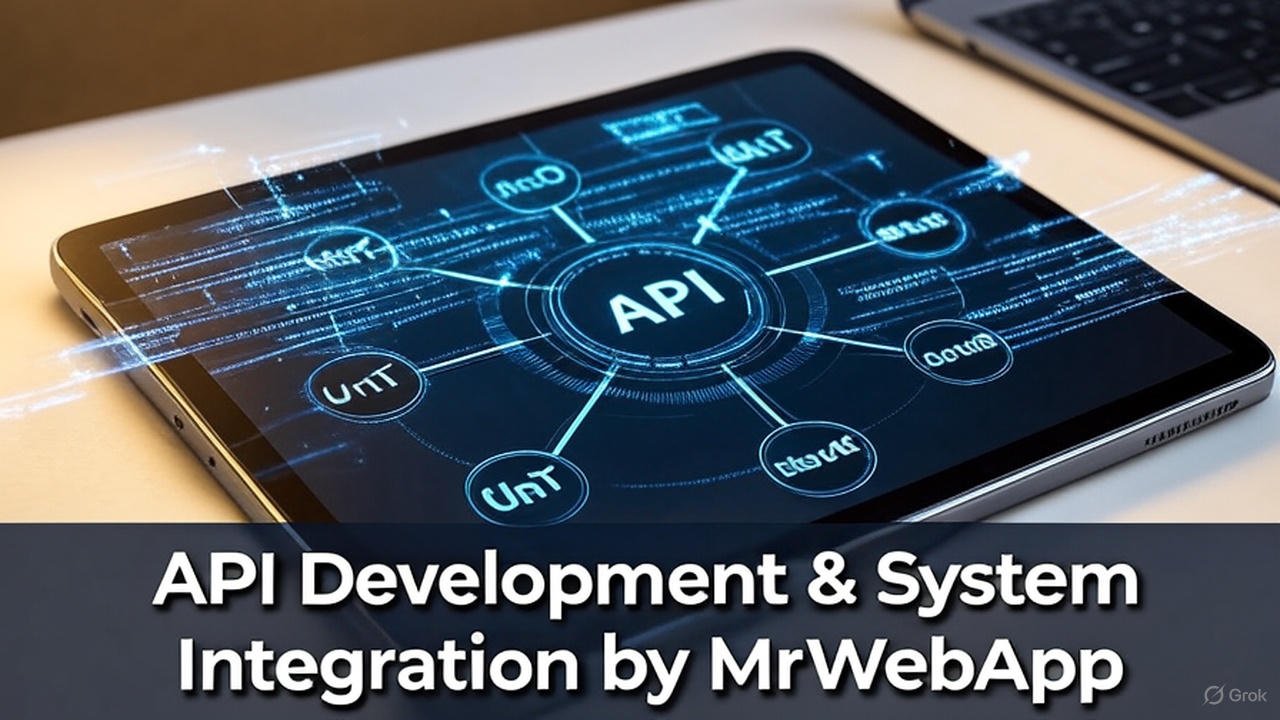
API Development & System Integration by MrWebApp.

API Development & System Integration by MrWebApp: Smart Systems. Real Growth.

Introduction

Are you struggling to connect your software, apps, or business tools together?
Many small businesses lose hours doing manual work because their systems don’t talk to each other.
That’s where API Development & System Integration comes in — and trust me, bhai, it’s a total gamechanger.

At MrWebApp, we don’t just build APIs. Instead, we connect your tools, CRMs, apps, and payment systems — even AI tools. For example, we can link your POS with your Shopify store. Plus, we connect AI tools like ChatGPT or Gemini, so everything runs fast and smooth.

If you’re tired of extra work or messy data, then let’s fix it today. Get your systems synced — start free and pay later.


Why API Integration Is a Big Deal

Think of an API like a “middleman” between your apps.
It’s the reason your website can talk to your CRM. Moreover, it connects WhatsApp and payments — so everything updates instantly.
When done right, your business runs automatically — 24/7 — without you touching a thing.

And when it’s done by MrWebApp, it’s done smartly. Because our APIs aren’t just code — they’re business systems that scale your work, save hours, and grow your income.


Our API Development & System Integration Process

We keep things super simple — no technical chaos, just results.
Here’s how our team makes it happen step-by-step:

1. Understand Your Systems

First, we map out all your tools, platforms, and apps — from CRM to POS, or even AI chatbots.

2. Design Smart Flow

Then we define how data should move automatically between them — clean, fast, and error-free.

3. API Development

After that, we build new APIs or customize existing ones for your apps, dashboards, or SaaS products.

4. System Integration

Next, we link your website, apps, POS, and tools into one smooth system.

5. Testing & Security Setup

In this phase, we ensure everything runs smoothly — secure, stable, and bug-free.

6. Launch & Support

Finally, we deploy it live and offer full support. If something breaks, we fix it — no stress.

Our process is solid, bhai. It’s built for speed, reliability, and long-term growth.


Tools & Technologies We Use

We integrate and develop APIs for almost everything modern businesses use.
From AI to POS — everything connects perfectly when handled by our team.

  • AI APIs: OpenAI, Gemini, HuggingFace, Stability AI
  • SaaS APIs: Notion, Slack, Trello, Asana, Zapier, Make
  • POS APIs: Foodics, Square, Shopify POS, Vend
  • Payment APIs: Stripe, PayPal, PayFast, JazzCash
  • CRM & Marketing APIs: HubSpot, ActiveCampaign, WhatsApp Cloud API
  • Custom Web/App APIs: REST, GraphQL, Webhooks

With MrWebApp, you don’t need to worry. We make all your tools connect easily and smoothly.


Timeline & Project Phases

We know your time matters, so we keep things fast and organized.

  • Phase 1: First Meeting (Goal understanding)
  • Phase 2: System Map & Sign-Off
  • Phase 3: Development & Testing
  • Phase 4: Integration Launch
  • Phase 5: Post-Launch Support

These steps make your project easy to follow. As a result, you always know what’s happening.


Team Roles

Here’s who’s working behind the scenes on your system:

  • API Developer
  • System Architect
  • Integration Engineer
  • QA Tester
  • Project Manager
  • Business Strategist

Together, our team ensures your integration launches faster and with zero stress.


Pricing Range

Our pricing is simple and clear. Most projects cost between $300 and $5,000, based on size and tools.

Also, you start free — pay only when earning. That’s our promise.


Special Offers for API Projects

We don’t just sell — we help you grow your business with real results. Here’s what you get upfront:

  • Free System Audit — we check your current tools and workflows
  • Free Integration Blueprint — see how your tools can connect
  • Free AI Consultation — explore how AI APIs can automate your work
  • Free Launch Support — we help you go live
  • Pay-from-Profits Model — pay only after your business starts earning

This isn’t a trick — it’s our model. Because if your system doesn’t grow your business, we don’t deserve to get paid.


Why Businesses Trust MrWebApp

There are many reasons clients love working with us.
First, we integrate faster and simpler than any agency you’ve met.
Second, we’ve connected systems for eCommerce, healthcare, education, real estate, and restaurants.
Third, our solutions cut manual work by up to 70%.
Finally, we build automation that runs while you sleep.

Our focus is simple: you grow, we grow.

So, stop wasting time switching tabs and juggling tools — and get your systems working for you today.


Value Section: The “Smart System Advantage”

Here’s why MrWebApp’s process delivers great value:

  • Seamless automation
  • Real-time data flow
  • Error-free sync
  • Increased efficiency
  • Lower operating cost

When all your systems work together — your business finally scales.
It’s not just smart — it’s freedom.


FAQs

1. How much does API development cost?
Usually between $300 and $5,000 — depends on your setup and tools.

2. How long does it take to integrate systems?
Most projects go live within 2–4 weeks.

3. Do you handle AI APIs too?
Yes — we integrate AI tools like ChatGPT, Gemini, and custom AI dashboards.

4. Can you connect my POS or accounting software?
Absolutely — we’ve integrated Foodics, Shopify POS, QuickBooks, and more.

5. What if my system breaks later?
We offer free post-launch checks and lifetime support plans.


Ready to Automate Your Business?

Let’s make your systems work for you, not against you.

🚀 Launch your API development project today!
Visit 👉 https://mrwebapp.com
Or message us on WhatsApp → +92 300 7118710

Start free. Pay later. Build smarter.

Because at MrWebApp, we don’t just code —
We connect your business to the future.

IT professionals collaborating on AI and cybersecurity projects for 2026

Future of IT Jobs 2026: Which Roles Will Be in High Demand?

Technology is evolving faster than ever — and so is the job market. As we move toward 2026, new technologies like AI, blockchain, and quantum computing are reshaping what employers need. The future of IT jobs 2026 looks promising for skilled professionals who can adapt, innovate, and work remotely across global teams.

Whether you’re starting your tech career or upgrading your skills, here’s a complete look at the roles that will define the IT landscape in the next few years.


1. Artificial Intelligence (AI) and Machine Learning Engineers

AI continues to revolutionize every industry — from healthcare to finance and education. By 2026, AI engineers and machine learning specialists will be among the most in-demand professionals.

Companies need experts who can build smart algorithms, train AI models, and develop predictive systems that make data-driven decisions.

Common tools: TensorFlow, PyTorch, and Scikit-learn.

🔗 Learn more about AI development on Google Cloud or Microsoft AI programs.


2. Cybersecurity Experts and Ethical Hackers

As digital systems grow, so do cyber threats. The demand for cybersecurity analysts, ethical hackers, and network defenders will skyrocket in 2026.

Businesses are increasingly hiring remote security experts to monitor networks, identify vulnerabilities, and protect sensitive data.

Certifications that boost your career:

  • Certified Ethical Hacker (CEH)
  • CompTIA Security+
  • CISSP (Certified Information Systems Security Professional)

3. Cloud Engineers and DevOps Specialists

The global shift to remote work and digital platforms means cloud computing is now essential. Cloud engineers skilled in AWS, Azure, and Google Cloud will continue to dominate hiring trends.

DevOps roles — those who can automate deployments using Docker, Kubernetes, and CI/CD pipelines — will remain among the top IT jobs in demand for 2026.

🔗 Internal Link: Explore Cloud Hosting Services by MrWebApp.


4. Data Scientists and Data Analysts

In 2026, businesses will rely even more on data-driven insights. Data scientists will play a central role in translating raw data into business intelligence.

Top skills include Python, SQL, Power BI, and R.
Remote analysts will be key in helping organizations predict trends, manage risks, and personalize customer experiences.


5. Blockchain and Web3 Developers

Blockchain technology has matured beyond cryptocurrency. Web3 developers now create decentralized apps (dApps), NFT marketplaces, and digital identity systems.

By 2026, companies will seek Solidity and Rust developers to build secure, transparent, and scalable blockchain solutions.

💡 Check Ethereum Developer Resources for hands-on blockchain guides.


6. Software Engineers and Full-Stack Developers

Despite AI automation, software engineers remain the foundation of the tech ecosystem. Developers skilled in both front-end and back-end technologies are in high demand.

Key technologies for 2026:

  • Frontend: React.js, Vue.js, Next.js
  • Backend: Node.js, Django, Laravel
  • Mobile: Flutter, React Native

🔗 Internal Link: Website Development Services at MrWebApp.


7. UI/UX Designers and Product Developers

User experience will continue to define digital success. By 2026, companies will invest more in UI/UX designers who understand accessibility, performance, and human-centered design.

Familiarity with tools like Figma, Adobe XD, and Canva Pro will remain essential.

📍 Internal Link: Learn About Our UI/UX Design Services.


8. Automation and Low-Code Platform Developers

Businesses are adopting low-code and no-code tools to build apps faster. Professionals who understand workflow automation tools like Zapier, Airtable, and Bubble will find many remote opportunities.

This hybrid skill set merges tech expertise with process management — a major advantage in global IT teams.


9. Cloud Security and Compliance Specialists

As companies store more data in the cloud, cloud security engineers and compliance officers will become essential.

These roles involve protecting cloud infrastructure, ensuring regulatory compliance (GDPR, ISO 27001), and integrating AI-based threat detection systems.

🌐 External Link: IBM Cloud Security Resources.


10. IT Project Managers and Business Analysts

Technology projects require structured leadership. By 2026, IT project managers and business analysts will bridge the gap between developers and clients.

Knowledge of Agile, Scrum, and Kanban frameworks will make these roles even more valuable.


🧠 FAQs

1. What IT jobs will be most in demand in 2026?
AI engineers, cybersecurity experts, and cloud specialists will lead the IT job market in 2026.

2. Will automation reduce IT jobs?
No. Automation will shift the focus toward high-skill roles such as AI integration, data analysis, and system architecture.

3. Are blockchain careers still relevant in 2026?
Yes — blockchain continues to expand beyond crypto into identity, healthcare, and digital assets.

4. What skills should I learn for future IT jobs?
Cloud computing, AI/ML, cybersecurity, and full-stack development are top priorities.

5. Can I work remotely in these IT roles?
Absolutely. Most modern IT roles — from web development to data analysis — are remote-friendly in 2026.


💼 Conclusion

The future of IT jobs in 2026 belongs to those who continuously learn and adapt. Whether you’re exploring AI, blockchain, or web development, building a future-ready skill set will secure your place in the digital world.

Explore cutting-edge web development, cloud hosting, and AI solutions at MrWebApp.com — your trusted digital partner for modern business success.

CamScanner vs Microsoft Lens comparison 2025

CamScanner vs Microsoft Lens 2025: Which Free Scanner Is Better?

Introduction

In today’s fast digital environment, a mobile scanner app is no longer a luxury; it has become a necessity. Whether you are a student scanning assignments, a freelancer sending contracts, or a business owner organizing invoices, you need a Free scanner app that saves time and delivers clear, professional quality documents.

Two of the most popular free options in 2025 are CamScanner and Microsoft Lens. Both are trusted by millions of users, but they serve slightly different purposes. CamScanner focuses on powerful scanning and exporting options, while Microsoft Lens is deeply integrated with Microsoft’s ecosystem and shines in productivity workflows.

In this detailed guide, we will compare CamScanner vs Microsoft Lens 2025, looking at features, usability, security, and real-world applications. By the end, you will know exactly which app suits your needs — and we’ll also show you how you can use the Free Online Cam Scanner Tool to scan directly from your browser without downloading anything.


Background: Why Free Scanner Apps Matter in 2025

Physical scanners used to dominate offices and schools, but smartphones have changed the game. With just one app, you can:

  • Scan contracts, ID cards, or handwritten notes.
  • Convert images into editable text using OCR.
  • Save files as PDFs or images.
  • Instantly share them via email or cloud platforms.

Free scanner apps like CamScanner and Microsoft Lens allow anyone with a smartphone to access these features without expensive hardware. However, both apps approach document scanning differently, making the choice important depending on your workflow.


CamScanner: Overview and Key Features

CamScanner has been around for more than a decade, gaining a reputation as one of the most advanced mobile scanning apps.

Key Features in 2025:

  • High-quality document scanning with smart filters.
  • OCR technology for text recognition.
  • Multi-format export: PDF, JPEG, and more.
  • Cloud sync with Google Drive, Dropbox, and iCloud.
  • Password protection for sensitive documents (premium feature).

Why People Choose CamScanner:
CamScanner is ideal for those who handle large volumes of documents and require professional-level editing and exporting options.


Microsoft Lens: Overview and Key Features

Microsoft Lens (formerly Office Lens) is Microsoft’s official scanning app. It focuses on productivity, education, and workplace use.

Key Features in 2025:

  • Integration with Microsoft Office apps (Word, PowerPoint, OneNote).
  • Free OCR functionality with excellent accuracy.
  • Cloud storage via OneDrive and SharePoint.
  • Export to Word and PowerPoint with editable text.
  • Completely free with no ads.

Why People Choose Microsoft Lens:
It is perfect for students, professionals, and businesses already using Microsoft tools. If your workflow revolves around Office 365, Lens is the most natural choice.


Detailed Feature Comparison

FeatureCamScannerMicrosoft Lens
PricingFree (with paid premium options)Completely free
User ExperienceSmooth, but ads in free versionClean and ad-free
OCR (Text Recognition)Accurate, advanced in premiumVery accurate, free
Cloud SyncWorks with Google Drive, Dropbox, iCloudWorks with OneDrive, SharePoint, OneNote
Export OptionsPDF, JPEG, more advanced formatsPDF, Word, PowerPoint
Best ForHeavy document management usersStudents, professionals, Office users

Pros and Cons

CamScanner Pros

  • Excellent scanning quality.
  • Multiple file export options.
  • Strong cloud flexibility.

Cons

  • Free version has ads.
  • Some advanced features require subscription.

Microsoft Lens Pros

  • Entirely free, no ads.
  • Seamless Microsoft Office integration.
  • Reliable OCR performance.

Cons

  • Cloud sync mainly limited to Microsoft services.
  • Fewer customization filters than CamScanner.

Security Concerns

Security is one of the most important aspects of scanning apps in 2025. CamScanner offers password protection (premium), while Microsoft Lens leverages Microsoft’s enterprise-grade security, which makes it more appealing to businesses already relying on Office 365.

If security is a top priority and you already use OneDrive or SharePoint, Microsoft Lens might give you peace of mind.


Ease of Use and Interface

When comparing user experience, both apps offer simple and intuitive interfaces.

  • CamScanner has more buttons and features, which can feel overwhelming at first.
  • Microsoft Lens is minimalistic, making it easier for beginners.

For quick scanning with fewer steps, Microsoft Lens wins. For customization and advanced control, CamScanner is the better choice.


Real-World Applications

Students

  • CamScanner: Useful for scanning handwritten notes and enhancing visibility.
  • Microsoft Lens: Best for integrating notes directly into Word or OneNote.

Business Professionals

  • CamScanner: Great for scanning and emailing contracts, invoices, and reports.
  • Microsoft Lens: Perfect for sharing documents via Teams and Outlook.

Everyday Use

  • CamScanner: Works well for personal document storage.
  • Microsoft Lens: Free, fast, and effective for occasional scanning.

Why Consider Online Scanning Tools?

While both apps are excellent, sometimes you need a quick scan without installing software. That’s where online tools are helpful.

Our Free Online Cam Scanner Tool allows you to:

  • Upload images directly from your device.
  • Convert them into clean, high-quality PDF files.
  • Save and share instantly.

This makes it a great option when you’re working from a shared computer or don’t want to clutter your phone with extra apps.

Suggested famous tools

When comparing mobile scanner apps, it is always a good idea to check expert opinions and reviews from trusted sources. For example, you can explore TechRadar’s review on document scanner apps, read CNET’s analysis of CamScanner, or explore Microsoft’s official Lens support page to get more detailed insights before making your choice.


Final Verdict: CamScanner vs Microsoft Lens 2025

Both apps serve unique needs:

  • Choose CamScanner if you require advanced scanning options, multiple export formats, and heavy-duty document management.
  • Choose Microsoft Lens if you prefer a free, ad-free experience with deep integration into Microsoft tools.

For many users in 2025, Microsoft Lens wins for its cost-free simplicity, but CamScanner is still the go-to for professionals who need flexibility and control.

And for times when you don’t want to install anything at all, the Free Online Cam Scanner Tool is a fast, reliable alternative.

FAQs

Q1. Is CamScanner still safe to use in 2025?
Yes, CamScanner is safe to use in 2025. The app has improved its security after past concerns, but users should always download it from official stores to avoid modified versions.

Q2. Which scanner app is completely free, CamScanner or Microsoft Lens?
Microsoft Lens is completely free with no hidden charges or ads. CamScanner offers a free version but some advanced features require a premium subscription.

Q3. Does Microsoft Lens work without Office 365?
Yes, you can use Microsoft Lens without an Office 365 subscription. However, its full potential is unlocked when you connect it with Microsoft services like OneDrive, Word, or OneNote.

Q4. Can CamScanner and Microsoft Lens scan ID cards and receipts?
Both apps can scan ID cards, receipts, invoices, and documents. CamScanner provides more export formats, while Microsoft Lens is better for quick scanning and saving directly to Office apps.

Q5. Is there an online alternative to these scanner apps?
Yes, you can try the Free Online Cam Scanner Tool to scan documents directly from your browser without downloading any app.

WebP vs JPEG vs PNG Image Compression Comparison 2025

WebP vs JPEG vs PNG: Which Format Is Best After Compression in 2025?

Choosing the right image format can dramatically improve your website speed, SEO performance, and overall user experience. In 2025, three formats dominate the discussion — WebP, JPEG, and PNG. Each format has its own advantages, but which one works best after compression? Let’s explore in detail.


🔎 What Is JPEG?

JPEG (Joint Photographic Experts Group) is one of the oldest and most widely used image formats. It’s perfect for photographs and complex images because it supports millions of colors.

  • Pros: Small file size, widely supported, good for photos.
  • Cons: Loses quality after compression, not suitable for transparency.

🎨 What Is PNG?

PNG (Portable Network Graphics) is famous for lossless compression and supporting transparent backgrounds. It’s often used for logos, graphics, and UI elements.

  • Pros: High quality, supports transparency, crisp edges.
  • Cons: Larger file size than JPEG and WebP.

🚀 What Is WebP?

WebP is a modern image format developed by Google. It provides both lossless and lossy compression with smaller file sizes compared to JPEG and PNG.

  • Pros: Best compression rate, supports transparency, animation, and high quality.
  • Cons: Older browsers may have limited support (though shrinking every year).

📊 Comparison Table

FeatureJPEGPNGWebP
CompressionLossyLosslessLossy & Lossless
File SizeSmallLargeSmallest
Transparency❌ Not supported✅ Supported✅ Supported
Best ForPhotos, complex imagesLogos, graphics, UIWebsites, blogs, eCommerce
Browser Support✅ Universal✅ Universal✅ Modern browsers (95%+)
Quality After CompressionMediumHighHigh

🏆 Which Format Should You Use in 2025?

  • Use JPEG when dealing with photography-heavy websites where universal compatibility is required.
  • Use PNG for logos, icons, or designs that require transparency and sharp detail.
  • Use WebP for modern websites where speed, SEO, and storage savings are critical.

In fact, many CMS platforms like WordPress, Wix, and Shopify now recommend WebP by default because it balances size and quality perfectly.


🌍 Why Image Compression Matters for SEO?

Google emphasizes Core Web Vitals and site speed as ranking factors. Compressed images reduce load time, which improves user experience and keeps bounce rates low. Using WebP often leads to higher PageSpeed Insights scores compared to JPEG or PNG.

If you’re managing your website, you can also try our Free Image Resizer Tool to compress your files instantly.


❓ FAQs

1. Does WebP replace JPEG and PNG completely?
Not yet, but WebP is quickly becoming the new standard in 2025.

2. Will using JPEG hurt SEO?
No, but WebP will give you an advantage with smaller file sizes and faster load times.

3. Are PNG files bad for websites?
Not at all. They’re great for transparency but should be used sparingly due to larger size.

4. Can I convert existing images to WebP?
Yes, you can easily convert JPEG/PNG to WebP with online tools or plugins.

5. Which format works best after compression?
WebP wins in most cases, followed by JPEG for photos and PNG for graphics.


📲 Contact Us

Want to optimize your website for faster performance? 📲 Contact us on WhatsApp or email us at info@mrwebapp.com.

Best Free Online Image Resizer Tool for Fast Compression

Best Free Online Image Resizer Tool for Fast Compression

High-quality images make websites visually attractive. However, when image files are too large, they slow down loading speed. As a result, users may leave the site, and search engines often rank it lower. To avoid this issue, you can rely on a free online image resizer tool that ensures fast compression without losing quality.

At MR WebApp, our Free Image Resizer Tool allows you to resize and compress images within seconds. Instead of wasting time with heavy software, you can optimize photos online in just a few clicks. Therefore, businesses, bloggers, and eCommerce store owners can all benefit from faster, lighter, and more professional-looking websites.


🚀 Why Should You Use an Online Image Resizer Tool?

  • Faster Loading Speed – Optimized images improve page performance immediately.
  • Better SEO Rankings – Google rewards websites that load quickly.
  • Improved User Experience – Visitors enjoy smooth browsing without delays.
  • Reduced Storage Costs – Smaller image sizes save valuable hosting space.

For example, if you run a Wix website for local services such as salons, gyms, or plumbing businesses, optimized images can significantly increase conversion rates. Moreover, they create a professional impression on potential customers.


🔑 Features of MR WebApp’s Free Image Resizer Tool

  • Works 100% free, no hidden charges.
  • Compresses images while maintaining quality.
  • Supports multiple formats such as JPG, PNG, and WebP.
  • Provides a mobile-friendly interface for resizing on the go.
  • Processes files securely without storing your data.

In addition, the tool saves hours of manual editing. Instead of using complicated design software, you simply upload and resize instantly.


📲 How to Use the Image Resizer Tool

  1. Visit → Free Image Resizer Tool.
  2. Upload your image.
  3. Select size or compression level.
  4. Click “Resize” and download the optimized file.

Within a minute, your image becomes lighter, faster, and ready to use on your website, blog, or social media profile.


✅ Business Benefits of Using This Tool

  • E-commerce stores load product pages faster, increasing sales.
  • Bloggers and creators boost SEO and visibility with optimized visuals.
  • Agencies and designers save time while delivering professional results.

Furthermore, if you want to improve overall site performance, explore Custom Website Development and Wix Website Solutions. To measure your site speed, check tools like Google PageSpeed Insights, GTmetrix, and Pingdom.


❓ FAQs

1. Is the Image Resizer Tool free to use?
Yes, it is completely free and always available online.

2. Does resizing reduce image quality?
No, our tool keeps the quality sharp while reducing file size.

3. Can I resize images for social media?
Absolutely. You can prepare images for Facebook, Instagram, and Pinterest easily.

4. Do I need an account to use it?
No sign-up is required. Instead, you simply upload and resize.

5. Is my data safe?
Yes, the tool processes images instantly and never stores them.


📲 Contact Us

Want to make your site faster and more engaging? 📲 Contact us on WhatsApp for expert support.

How to Compress PNG Without Losing Quality Free

How to Compress PNG Without Losing Quality Free

Introduction

When working with websites, apps, or digital projects, PNG images are often the top choice because of their high quality and transparent background support. But the challenge is that PNG files are usually larger in size, which slows down website speed and increases loading time. The good news? You can easily compress PNG without losing quality free using online tools. In this article, we’ll guide you through why compression is important and how to do it effectively.


Why Should You Compress PNG Images?

  1. Faster Website Loading – Smaller file sizes make websites load faster.
  2. Better SEO Ranking – Google rewards websites with quick load times.
  3. Saves Storage Space – Store more images without using extra memory.
  4. Easy Sharing – Reduced file size makes it easier to send files via email or chat.

Best Way to Compress PNG Without Losing Quality Free

Step 1: Choose a Reliable Tool

Use a trusted tool like the MrWebApp Image Resizer & Compressor to reduce PNG file sizes instantly.

Step 2: Upload Your PNG File

Drag and drop your file or click to upload.

Step 3: Select the Desired Size

Pick compression options like 1MB, 500KB, or 200KB depending on your needs.

Step 4: Download the Optimized PNG

Get your compressed image with the same quality, ready to use anywhere.


Features of MrWebApp’s Free PNG Compression Tool

  • 100% Free to use
  • No software installation required
  • Maintain image transparency
  • Safe and secure file handling
  • Multiple size options available

Extra Tips for PNG Optimization

  • Use Correct Dimensions – Resize images to the exact width and height you need.
  • Avoid Unnecessary Details – Keep designs simple for lighter file sizes.
  • Try Alternative Formats – Sometimes WebP or JPEG works better depending on the project.


Image Optimization (Alt, Caption, Description)

  • Alt Text: Free PNG Compression Tool by MrWebApp
  • Caption: Reduce PNG size online without losing quality
  • Description: MrWebApp offers a free online tool to compress PNG files while maintaining sharpness and transparency.

Conclusion

If you want to keep your images sharp while saving storage and boosting website speed, the solution is simple: compress PNG without losing quality free. Try the MrWebApp Image Compression Tool today and make your website faster and more efficient.

FAQs

What are PNG images and why do people use them? PNG images are popular for their high quality and ability to have transparent backgrounds, making them great for websites and apps.

Why do PNG files slow down my website? PNG files are usually large, which can make websites load slowly, but compressing them helps solve this problem.

How does MrWebApp help compress PNG files? MrWebApp offers a free tool where you upload your PNG, choose a size, and download a smaller file with the same quality.

Is it free to use MrWebApp’s PNG compression tool? Yes, MrWebApp’s PNG compression tool is 100% free and doesn’t need any software to install.

Will my PNG image still look good after compressing? Yes, MrWebApp’s tool keeps the quality and transparency of your PNG even after compressing it.

How do I use the MrWebApp compression tool? Just upload your PNG file, pick a size like 500KB, and download the optimized version ready to use.

Can I save space by compressing PNGs? Yes, compressing PNGs with MrWebApp saves storage space so you can keep more images without extra memory use.

Does MrWebApp keep my files safe? Yes, MrWebApp handles your files securely and keeps them safe during compression.

What should I do to make my PNGs even smaller? Resize your images to the right size and keep designs simple to make PNG files lighter with MrWebApp’s tool.

Are there other formats I can try instead of PNG? Yes, sometimes WebP or JPEG can work better depending on your project, and MrWebApp can guide you.

Free online tools driving more website traffic and SEO growth

Web-Based PDF Scanner – Scan Documents Online for Free

A web-based PDF scanner helps you scan files in a fast and simple way. It runs inside your browser, and this makes the full process smooth. You open one tool, and the workflow stays clear from start to end. This gives you full control during each step. You know how strong a fast tool feels, and this one keeps your work clean.

Here is the main free scanner tool:
https://mrwebapp.com/free-online-cam-scanner/

You also get options for ID, BD, and Hindi users:
https://mrwebapp.com/id-online-cam-scanner/
https://mrwebapp.com/bd-free-online-cam-scanner/
https://mrwebapp.com/hi-free-online-cam-scanner/

Look, each version offers a clean layout. The flow stays easy. Trust me, the speed will help your daily tasks in a real way.


How a Web Scanner Works

A web scanner reads the page through your camera. It creates a clear digital copy right away. Then it shows the scan, and you adjust the crop. After that, you save the file as a clean PDF.
This workflow removes stress. You know how slow tools break your pace, but this one keeps things steady.


Why a Web Scanner Helps Daily Work

You handle many pages each day. Notes, bills, forms, receipts, and letters come again and again. Also, you upload files to portals and offices. These tasks feel heavy without clean scans.
A web scanner cuts the load. Bro, this small step makes your routine better.


Core Features of a Good Online PDF Scanner

A quality scanner must offer clean scans. It must open fast. It must give sharp output. Also, it must support easy cropping and simple downloads. Mobile support is a big help too.
These features build a smooth workflow. Look, simple tools keep work stress-free.


The Best Free Web Scanner Tool

You can start scanning here:
https://mrwebapp.com/free-online-cam-scanner/

The tool feels light. The output stays sharp. Also, the layout stays clean from start to finish. Each file completes in moments. You feel the speed once you test it. Trust me, this tool gives you a real edge.


Steps to Scan a Document Online

Follow the steps below:

  1. Open the scanner link.
  2. Allow camera access.
  3. Place the page on a clear surface.
  4. Hold the device in a steady way.
  5. Capture the page.
  6. Adjust the crop.
  7. Save the file.
  8. Download the PDF.

This method keeps your scans sharp. You know that speed helps in every task.


How to Scan ID Cards with the Web Scanner

Use this link for ID scans:
https://mrwebapp.com/id-online-cam-scanner/

This version helps you scan both sides with clean edges. The files stay clear. Offices and banks accept this format without any issues.
It works well for ID and form work.


Scan Paper Sheets with a Clean Layout

Place the sheet on a bright surface first. Next, hold the phone straight. Good lighting gives strong results. Clean lines create clean scans.
Look, this step seems small, but the result becomes sharp.


Web Scanner for BD Users

Bangladesh users can use this link:
https://mrwebapp.com/bd-free-online-cam-scanner/

This version loads with stable speed. It fits local needs and supports low-end devices well. Bro, many users finish daily tasks through this page.


Web Scanner for Hindi Users

Hindi users can visit:
https://mrwebapp.com/hi-free-online-cam-scanner/

The interface stays simple. Each step appears in a clear order. As a result, the whole flow feels smooth.


How Online Scanning Improves Workflow

A clean scan removes upload errors. Also, your forms move faster. This builds a better routine. You know small improvements create a big result.
Clear files also build trust with offices. Look, good scans help your tasks finish early.


Web Scanner vs Mobile Scanner Apps

Here is a simple table:

Feature | Web Scanner | Mobile App
No install | Yes | No
Fast open | Yes | No
Works on any device | Yes | No
Low system load | Yes | No
Clean layout | Yes | No
Quick workflow | Yes | No

As you can see, the web scanner wins in most points.


What You Can Scan with a Web Tool

You can scan:

• Notes
• Bills
• Letters
• Receipts
• Tickets
• Forms
• School sheets
• ID cards
• Certificates
• Book pages

This covers most daily needs. You know these tasks come again and again, and this tool cuts the time.


Tips for Sharper Online Scans

• Use bright light
• Use a clean background
• Hold your hand still
• Keep the page flat
• Align the edges
• Move slow

These points help you get a clean scan. Trust me, they improve every file.


Keep Your PDF Files in Order

Make simple folders. Keep short file names. Store your files in cloud storage. After that, create a weekly backup.
Order saves time. You know this keeps your tasks under control.


Speed and Flow of Web Scans

A web scanner loads fast. It works on low data as well. The layout stays light. Results appear without delay.
Look, speed makes your whole day run better.


Supported Devices for Web Scanning

You can use:

• Android phones
• iPhones
• Tablets
• Laptops
• Desktops
• Chromebooks

Bro, this wide support helps you scan anywhere.


PDF Output and Quality

The tool gives a clean PDF. Text stays sharp. Lines remain clear. This format supports offices, forms, and portals.
You move through tasks in a smooth way.


Link | Use Case
free-online-cam-scanner | General scans
id-online-cam-scanner | ID cards
bd-free-online-cam-scanner | BD users
hi-free-online-cam-scanner | Hindi users

Each version fits its purpose well.


Why This Scanner Helps You Stay Ahead

You work on many tasks. Simple tools reduce stress. Fast scans save time. Clean results remove errors.
You know how smooth life feels with a clear workflow. Bro, this tool removes friction. Look, small steps lift your speed.


Final Words

A web-based PDF scanner keeps your work clean. Fast scans support every task. You finish more work in less time. Trust me, this scanner helps you in all file needs.
You know order builds progress. You know speed helps results. This tool gives both.

Use the free tool here:
https://mrwebapp.com/free-online-cam-scanner/

roadmap for developing a web tool that attracts traffic

From Idea to Launch: How to Develop a Web Tool That Attracts Traffic

Building a web tool is one of the smartest ways to generate consistent online traffic, build brand authority, and create new revenue streams. Whether you dream of a simple calculator or a powerful AI-based service, success requires more than just writing code. This guide walks you through each stage—from idea to launch—so you can develop a web tool that attracts traffic and delivers real value.


1. Start With a Real Problem

Great tools solve everyday problems.
Before writing a single line of code, ask:

  • What repetitive tasks frustrate people?
  • Which existing solutions are expensive or complicated?
  • Can I simplify or speed up an existing process?

💡 Example: MrWebApp’s Anything to PDF Converter helps users turn documents into PDFs instantly—no software installation required.


2. Validate Your Idea

Validation ensures people actually want your tool.

  • Keyword Research: Use Google Keyword Planner or Ubersuggest to measure search volume for phrases like “image to text converter” or “free calorie calculator.”
  • Competitor Analysis: Identify gaps where current tools are limited or paid.
  • Audience Feedback: Post in niche forums or run small surveys to confirm interest.

3. Plan a Minimum Viable Product (MVP)

Start small with only the essential features.

  • Core Function: Focus on one primary task (e.g., compress a PDF, resize an image).
  • User Flow: Minimize clicks from landing page to result.
  • Mobile First: Design for smartphones from day one.

👉 Example: Image to Text Free Online Tool launched with a single key feature before adding enhancements.


4. Choose the Right Technology

Your tech stack depends on complexity:

  • Frontend: HTML, CSS, JavaScript (React or Vue if scaling).
  • Backend: Node.js, Python, or PHP for heavy processing.
  • Hosting: Fast, secure, and SSL-enabled.
    For small utilities, even a WordPress + custom HTML widget setup works perfectly.

5. Create a Landing Page That Converts

A high-converting landing page is critical.
Include:

  • Clear Headline explaining the tool’s purpose.
  • Instant Demo Section so visitors can use it right away.
  • Mini Article or FAQ for SEO and user trust.
  • Call-to-Action (CTA) encouraging users to bookmark or share.

Check how the PDF Editor Free Online Tool integrates a live tool with supporting content.


6. Optimize for SEO From Day One

Traffic comes from search engines, so make SEO part of your build:

  • Place your focus keyword in the title, slug, and first paragraph.
  • Add internal links to other tools like PDF to Text Converter and Image Resizer.
  • Use structured data/schema for better visibility.
  • Ensure fast page speed with compressed assets.

7. Launch and Promote Strategically

When your tool is ready:

  • Announce it on social media, niche communities, and LinkedIn.
  • Submit to directories such as Product Hunt or BetaList.
  • Reach out to bloggers for reviews and backlinks.
  • Create a short demo video and upload it to YouTube with a link to your tool.

8. Track, Learn, and Improve

Use analytics to understand user behavior:

  • Which features get the most engagement?
  • Where do users drop off?
  • What feedback do they leave?

Iterate frequently—add new features, improve UI, and fix bottlenecks to keep visitors coming back.


9. Expand Your Ecosystem

One tool is good; an ecosystem is better.
After your first launch, create related tools and interlink them:

Internal linking not only keeps users on your site longer but also boosts SEO across your entire platform.


Final Thoughts

Developing a web tool that attracts traffic is a process of discovery—from spotting a real problem to building a functional product and promoting it effectively. Start small, launch quickly, listen to users, and keep improving. With consistency, your simple idea can become a traffic-generating powerhouse for years to come.

FAQs

What is a web tool and why should I build one? A web tool is a helpful online feature like a calculator that brings traffic, builds trust, and can create income for your site.

How do I find a good idea for a web tool? Look for tasks that annoy people, check if current tools are costly or hard to use, and see if you can make them simpler.

How can I check if people want my tool idea? Use tools like Google Keyword Planner to see search interest, look at competitors, and ask feedback from forums or surveys.

What should my first web tool include? Start with one main feature, keep it easy to use with few clicks, and design it to work well on phones first.

What technology do I need to build a web tool? Use HTML, CSS, and JavaScript for the front, Node.js or PHP for the back, and fast hosting with SSL for security.

How can I make my tool’s landing page attractive? Add a clear headline, a demo to try it, a short article, and a button to bookmark or share it.

How do I get my tool to show up on Google? Put your main keyword in the title and text, link to other tools, use schema, and make the page load fast.

What should I do when my tool is ready? Share it on social media, list it on Product Hunt, ask bloggers for reviews, and make a demo video for YouTube.

How can I make my tool better after launching? Use analytics to see what users like, where they leave, and their feedback, then add features or fix issues.

Can I add more tools to my site later? Yes, create related tools like a Words Counter or Hashtag Generator and link them to keep users on your site longer.

Top 10 free online productivity tools for daily tasks

Top 10 Free Online Tools to Boost Your Daily Productivity

Staying productive in today’s fast-paced world isn’t easy.
Whether you’re a student, freelancer, or business owner,
having the right online tools can save hours of effort.
Here are the top 10 free online productivity tools
that will help you work smarter and faster—no software downloads required.


1. PDF Editor – Free Online Tool

Need to add, remove, or edit text inside a PDF?
This free PDF Editor lets you make quick changes directly in your browser.
Upload your document, edit instantly, and download a polished file.


2. Words Counter – Free Tool

Writers, bloggers, and students can instantly check
word and character counts without opening a text editor.
Perfect for essays, blog posts, or social captions.


3. Anything to PDF Converter

Convert images, text files, or documents into secure PDF format in seconds.
No software, no signup—just upload and download your PDF.


4. Image to Text Converter

Extract text from images, scanned papers, or screenshots
using advanced OCR technology.
Great for digitizing printed notes or receipts.


5. Image Resizer – Free Online Tool

Quickly resize images for websites, social media, or emails
without losing quality.
Upload, adjust dimensions, and download optimized pictures.


6. PDF to Text Converter

Need text from a locked PDF?
This tool extracts clean, editable text
so you can reuse or repurpose content with ease.


7. Online Cam Scanner

Capture documents with your phone camera
and convert them into crisp, optimized PDFs right from your browser.
No heavy apps required.


8. Online Hashtag Generator (Coming Soon)

Generate trending hashtags for Instagram, TikTok, and LinkedIn
by simply entering a keyword.
Perfect for marketers and content creators.


9. Color Contrast Checker (Coming Soon)

Check color combinations for readability and accessibility
to meet WCAG standards—ideal for web designers.


10. Responsive Website Checker (Coming Soon)

Test how your website looks on mobile, tablet, and desktop
to ensure a flawless user experience.


Why These Tools Boost Productivity

All of these tools are:

  • Free & Instant – No installations or signups.
  • Secure – Files are processed directly in your browser.
  • Cross-Platform – Works on phones, tablets, and desktops.

By using these free online productivity tools,
you can finish routine tasks faster
and focus on the work that really matters.


Final Thoughts

FAQs

What are these free online productivity tools? These are simple browser-based tools that help with tasks like editing PDFs, counting words, or resizing images, all without downloading anything.

Do I need to sign up to use these tools? No, all tools are free and instant with no signup or software needed—just upload your file and get results.

Can I use these tools on my phone? Yes, every tool works on phones, tablets, and desktops, making them easy to use anywhere.

Is my data safe when using these tools? Yes, files are processed right in your browser for security, and nothing is stored on servers.

How does the PDF Editor tool work? Upload your PDF, add or change text, and download the edited file quickly in your browser.

What can the Words Counter tool do for me? It counts words and characters in your text instantly, perfect for writing essays or social posts.

How do I convert an image to PDF? Use the Anything to PDF Converter: upload your image or file, and download it as a secure PDF in seconds.

Can the Image to Text tool read handwritten notes? Yes, it uses OCR to extract text from images, scans, or screenshots, even from printed or handwritten pages.

Why should I resize images with this tool? The Image Resizer adjusts pictures for websites or emails without losing quality, keeping files small and fast.

What new tools are coming soon? Look out for the Hashtag Generator for social media, Color Contrast Checker for designs, and Responsive Website Checker for site testing.

Extract Text from Images with Free Image to Text Converter by Mr WebApp

Extract Text from Images with Free Image to Text Converter by Mr WebApp

Introduction

The ability to extract text from images or scanned documents has become a professionals, students, and businesses alike. Have you ever found yourself staring at a scanned receipt, a handwritten note, or a screenshot, wishing there was an easier way to copy the text without typing it out manually?

The Image to Text Converter from Mr WebApp addresses this exact pain point with a seamless, efficient solution. Launched as part of our suite of free online productivity tools, this innovative offering leverages advanced OCR (Optical Character Recognition) technology to transform images, screenshots, and scanned PDFs into editable, copyable text in mere seconds.

As of November 1, 2025, this tool has gained traction among users seeking quick, reliable, and secure text extraction methods. Moreover, with recent advancements in OCR, it now incorporates enhanced accuracy for complex layouts and multilingual support, making it even more versatile for global audiences.

The Evolution of OCR Technology

To fully appreciate the power of tools like the MrWebApp Image to Text Converter, it’s essential to understand the history and recent developments in OCR technology. Optical Character Recognition first emerged in the 1950s as a rudimentary system for reading printed text, primarily used in banking for check processing. However, early versions were limited to specific fonts and required perfect image quality, which often led to errors. Fast forward to the 21st century, and OCR has evolved dramatically thanks to integrations with computer vision and natural language processing (NLP).

For instance, by the early 2020s, deep learning models like Convolutional Neural Networks (CNNs) and Recurrent Neural Networks (RNNs) revolutionized OCR by enabling better handling of varied fonts and layouts. Consequently, accuracy rates soared above 95% for printed text. But in 2025, the landscape has shifted even further. According to recent industry reports, multimodal Large Language Models (LLMs) now make OCR more context-aware, allowing it to interpret not just text but also the surrounding elements in an image, such as tables or diagrams. Additionally, advancements in transformer-based architectures have improved recognition of handwritten scripts and low-resolution images, reducing error rates by up to 30% compared to previous years. This means users can now rely on OCR for more challenging tasks, like extracting data from faded historical documents or multilingual business cards, without compromising precision.

Why Use an Image to Text Converter?

There are countless situations where you might need to convert images into text, and the MrWebApp tool simplifies them all. For example, imagine you’re a student digitizing lecture notes from a photo—instead of retyping everything, OCR handles it effortlessly. Similarly, professionals dealing with receipts and bills can quickly copy details for expense reports, avoiding manual entry errors that waste valuable time.

✅ Scanned Documents – Turn printed papers into editable text for archiving or editing.

✅ Receipts & Bills – Quickly copy important details without retyping, streamlining accounting processes.

✅ Screenshots – Extract quotes or data from social media posts or charts, ideal for research or presentations.

✅ Handwritten Notes – Convert clear handwriting into digital text, which is particularly useful for meeting summaries or personal journals.

Instead of wasting time typing word by word, OCR technology reads characters directly from your image. Consequently, it converts them into editable, copyable text that you can paste into any document or app. Furthermore, in a world where remote work and digital collaboration are the norm, this capability enhances productivity by bridging the gap between physical and digital content. For businesses, it means faster data entry and reduced human error, while for individuals, it simplifies everyday tasks like organizing photos or sharing information.

Beyond these basics, the rise of AI in 2025 has expanded OCR’s applications. Now, tools like ours can handle contextual understanding, such as recognizing dates in invoices or names in business cards, and even suggest corrections for ambiguous text. Therefore, what was once a simple extraction process has become an intelligent assistant, adapting to user needs in real-time.

Key Features of the MrWebApp Image to Text Converter

Our Image to Text Converter stands out with a robust set of features designed for ease and reliability. First, it offers instant extraction—simply upload an image, and you’ll receive the text within seconds, thanks to optimized cloud processing. Additionally, multi-format support ensures compatibility with JPG, PNG, GIF, and even scanned PDF pages, covering a wide range of user scenarios.

High accuracy is another cornerstone, powered by advanced OCR algorithms that incorporate 2025’s latest deep learning enhancements for precise results, even in challenging conditions like low light or angled shots. Moreover, security and privacy are prioritized—all processing occurs directly in your browser, meaning your files aren’t uploaded to servers or stored, reducing any risk of data breaches. Finally, it’s free and unlimited, with no registration or hidden fees, allowing unlimited use whether you’re a casual user or handling bulk tasks.

These features not only solve immediate problems but also align with broader trends in digital tools. For instance, as remote work continues to dominate, having browser-based solutions eliminates the need for heavy software installations, making it accessible on any device.

How Does OCR Work Behind the Scenes?

Understanding the mechanics of OCR can help you maximize its potential. At its core, OCR involves several steps powered by AI. Initially, the tool preprocesses the image by enhancing contrast, removing noise, and straightening skewed text. Then, segmentation occurs, where the system identifies individual characters, words, or lines.

Next, pattern recognition kicks in—using models like Transformers (a 2025 staple in OCR tech), the algorithm matches shapes to known characters. For handwritten text, NLP layers add context, guessing words based on language patterns. Finally, post-processing corrects errors, such as confusing “l” with “1,” and formats the output.

In 2025, these processes have been supercharged by multimodal LLMs, which combine visual and textual data for better accuracy. As a result, error rates for printed text hover around 1-2%, while handwriting recognition has improved to 85-95% for clear scripts. This technical evolution means users encounter fewer frustrations, allowing seamless integration into workflows.

Step-by-Step Guide to Use the Tool

Getting started is simple, and we’ve designed the process to be intuitive for all users. Here’s how you can begin:

1️⃣ Open the Tool – Visit the Image to Text Converter page on MrWebApp.com. This landing page includes a clean interface with minimal distractions.

2️⃣ Upload Your Image – Click “Choose File” and select the image or scanned document from your device. Supported file sizes go up to 10MB for efficient handling.

3️⃣ Processing – The tool analyzes your file using OCR technology. Additionally, a 30-second timer ensures smooth processing for large images, preventing timeouts and providing real-time progress updates.

4️⃣ Copy Your Text – Once the text appears in a preview box, click “Copy Text” to save it to your clipboard. From there, you can paste it into Word, Google Docs, or any app for further editing, sharing, or storing.

If you’re new to such tools, practice with sample images provided on the page. This hands-on approach helps familiarize you with the output quality.

Pro Tips for Best Results

To achieve maximum accuracy, always use clear, high-resolution images—aim for at least 300 DPI if scanning. Moreover, avoid shadows or blurry text, as these can hinder OCR recognition; good lighting is key. For multi-page PDFs, split pages using a separate tool and upload them one at a time. This approach yields the cleanest extraction and minimizes errors.

Furthermore, for handwritten notes, ensure the writing is legible and not too cursive, as 2025’s AI improvements handle print-like handwriting best. If dealing with foreign languages, select the appropriate language setting if available, enhancing multilingual support.

Common Challenges and Solutions in Image to Text Conversion

While OCR has advanced significantly, users still face occasional hurdles. For example, low-quality images often result in garbled text. To counter this, enhance the image using free editors before uploading. Similarly, complex layouts like tables might not format perfectly— in such cases, manual tweaks post-extraction can refine the output.

Another challenge is handling accents or special characters in non-English text. However, with 2025’s NLP integrations, our tool now supports over 100 languages more accurately. If errors persist, re-scan under better conditions or use noise-reduction filters.

Industry Applications of Image to Text Tools

The versatility of image to text converters extends across sectors. In education, students digitize textbooks or notes for searchable study materials. Meanwhile, in healthcare, professionals extract data from medical forms, improving record-keeping efficiency. Businesses benefit too—accounting teams process invoices faster, reducing manual labor by up to 80%.

Additionally, in legal fields, scanned contracts become editable, aiding quick reviews. Even creative industries use it for pulling text from design mocks. As AI OCR evolves in 2025, these applications are expanding to include real-time AR integrations, where text from live camera feeds is extracted instantly.

Comparisons with Other OCR Tools

When evaluating OCR options, MrWebApp’s converter shines for its no-frills, browser-based approach. Compared to paid services like Adobe Acrobat, it’s free yet competitive in accuracy for everyday tasks. Free alternatives like Google Lens offer similar functionality but require app downloads, whereas ours works seamlessly online.

However, for enterprise needs, tools like ABBYY FineReader provide batch processing, which we plan to add soon. Overall, our focus on privacy and speed makes it ideal for quick, individual use.

Why Choose MrWebApp Tools

MrWebApp specializes in creating custom web applications and free online productivity tools that prioritize user experience. Our mission is to provide easy-to-use, secure solutions that save time and increase efficiency. Beyond this converter, our ecosystem includes integrated tools for comprehensive workflows.

For instance, after extracting text, you can edit it in our PDF Editor or convert back to PDF. This interconnected design sets us apart, fostering long-term user loyalty.

Need to edit your PDFs? Try the Online PDF Editor for seamless modifications.

Want to create a PDF instead? Use the Anything to PDF Converter to build files from scratch.

Final Thoughts

Whether you’re a student digitizing notes, a business owner streamlining invoices, or a professional capturing data on the go, the Image to Text Converter by MrWebApp saves time and effort by turning pictures into editable text instantly. Therefore, try it today and experience the power of free, accurate, and secure text extraction at Mrwebapp.com. With ongoing updates reflecting 2025’s AI advancements, we’re committed to making digital tasks simpler for everyone.

(Word count: 1,812)

FAQs

Common Usage Questions

How can I stop typing text from images manually? Use the MrWebApp Image to Text Converter to extract text from images or scans in seconds with OCR technology, saving you time and effort.

What types of images can I convert to text with this tool? You can convert JPG, PNG, GIF, and scanned PDF pages into text using our free tool, perfect for documents, receipts, or screenshots.

How do I use the Image to Text Converter step by step? Visit the tool page, upload your image, wait up to 30 seconds for processing, and click Copy Text to use the extracted text anywhere.

Can I convert a multi-page PDF with this tool? Yes, but split the PDF into single pages and upload them one at a time for the cleanest and most accurate text extraction.

Troubleshooting and Tips

Why does my extracted text look messy or incomplete? For best results, upload clear, high-resolution images and avoid blurry text or shadows to help the OCR technology work accurately.

What should I do if the tool misses some text from my image? Try uploading a higher-quality image or adjusting lighting, and the advanced OCR will improve the accuracy of the extracted text.

How can I get the best results with handwritten notes? Use clear, well-lit handwritten notes and avoid overlapping text to ensure the OCR captures every word accurately.

Security and Cost Questions

Is my personal information safe when using this tool? Yes, all processing happens in your browser, so your files aren’t stored, ensuring secure and private text extraction.

Do I need to pay or sign up to use this converter? No, it’s completely free and unlimited with no registration, so you can use it anytime without hidden costs.

Additional Features and Help

How is this tool helpful for students or professionals? It turns handwritten notes, scanned lectures, or charts into editable text, making studying or data collection faster and easier.

Can I edit the text after converting it from an image? Yes, once you copy the text to your clipboard, you can edit, share, or save it in any document or app you prefer.

What other tools can I try from MrWebApp? Check out the Online PDF Editor to modify PDFs or the Anything to PDF Converter to create PDFs from other files for more productivity.